
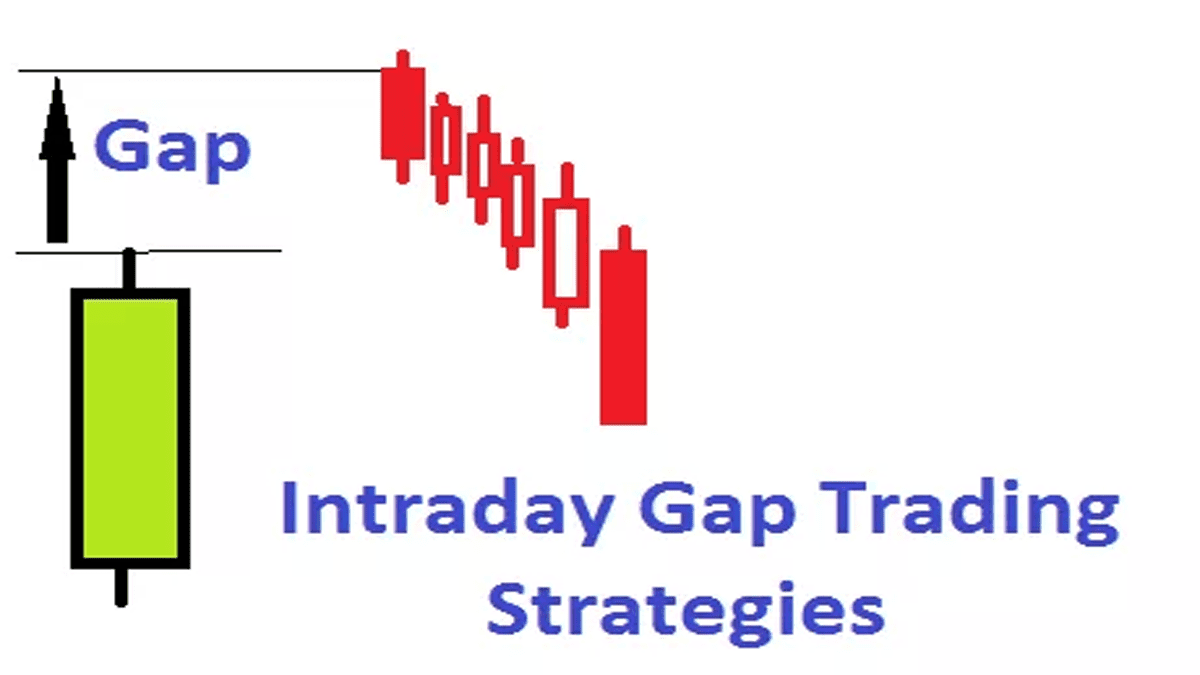
Gap trading is a simple and linear trading approach in which trading discipline plays a big role. A systematic approach to trading is what is required to trade gaps in price. Gap trading strategies can be applied in daily, weekly, and monthly charts but today we will focus on intraday gap trading strategies.
What is a Gap?
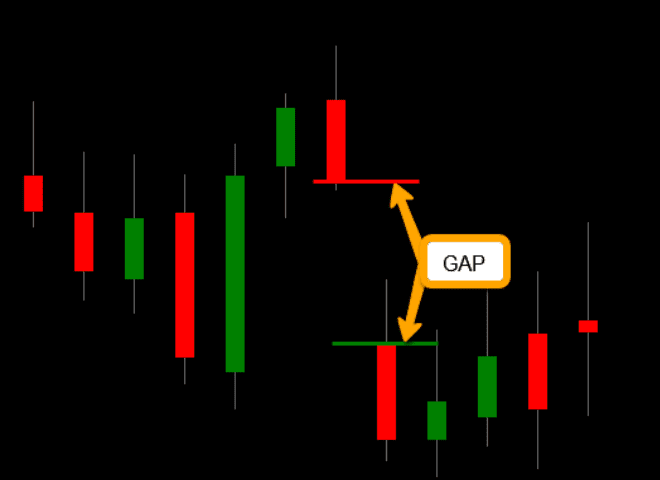
A gap in price is essentially a zone where little or no trade has taken place after the close of the previous candle. Therefore a gap appears between the close of the previous candle and the start of the current candle. Here, the assets price chart shows a definite gap in the standard price pattern.
GAP = Today’s Open minus Yesterday’s Close.
Why are Gaps Created?
Gaps in price happen for many reasons. They can occur due to result announcements, important news releases affecting the price, simple buying or selling pressure, or simple market noise.
Reasons for Trading the Gap
- Gap trading is easy – even a newbie in the market can adopt these strategies.
- No need to time the market – you only need to enter a market order at the open.
- The exit is predefined – therefore no need to sit tight on your order all through the day.
- Price gaps occur frequently – hence it is easy to find many trading opportunities.
- Risks are limited – no need to take overnight risks.
- Intraday gap trading strategies work equally well in bull and bear markets – no need to predict (!) the next move of the market.
- You can trade these strategies even without the use of charts.
- Strategies can be prepared in a very short time – no need to sit and study for long hours after the market closes.
- Gaps have inherent bias and edge. Gaps fill most of the time giving trading opportunities.
- Understanding market bias will lead to trade breakaway gaps giving bigger profit opportunities.
Types of Gaps
There are 4 major types of gaps that occur in the stock markets.
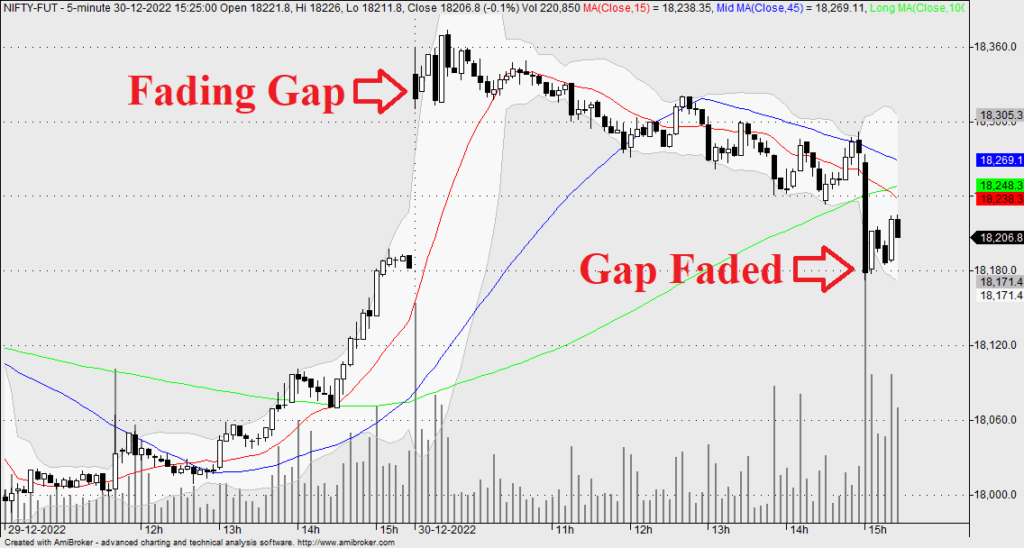
Fading Gap – A fading gap is a price gap that occurs when the market price opens above or below the previous day’s closing price, but then quickly moves back to fill the gap. Fading gaps are also known as “common gaps” and occur frequently in the market. This type of gap occurs in the price movement of the security without any significant change in the overall trend. They are typically caused by market noise or a lack of liquidity and can be exploited by traders who use gap trading strategies.
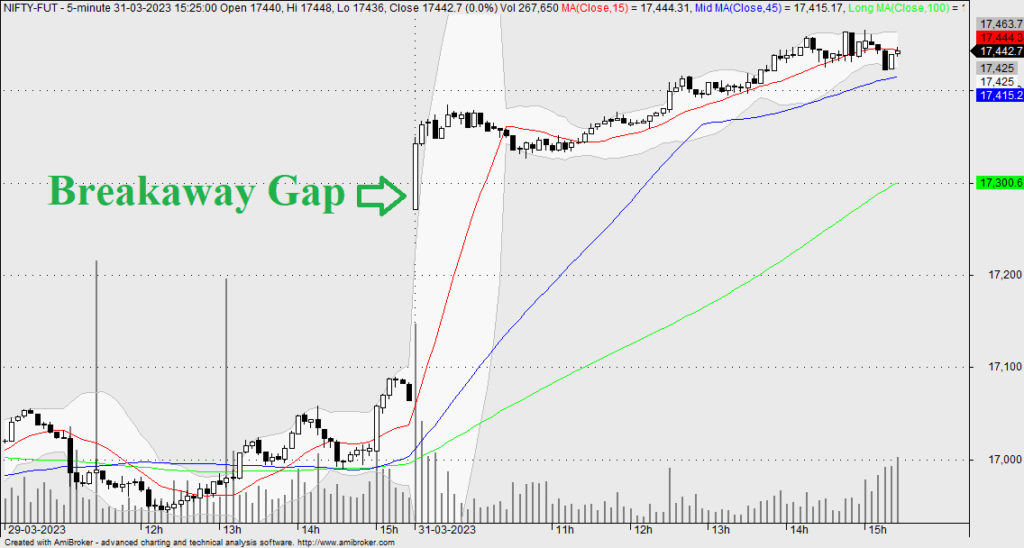
Breakaway Gap – A breakaway gap is a price gap that occurs when there is a significant change in the market sentiment or when a new trend begins. This type of gap is often accompanied by a trend day with high trading volume and represents a sudden shift in investor sentiment. Breakaway gaps can be bullish or bearish depending on the direction of the price move.
Runaway Gap – A gap that occurs during the middle of a trend, indicating a continuation of the trend.
Exhaustion Gap – A gap that occurs at the end of a trend, indicating a potential reversal in the price movement of a security.





Intraday Gap Trading Strategies According to Gap Types
We need to apply strategies for both of these types of gaps with strict stop loss. Long-term (10 years data) data analysis shows that in more than 70% of cases, price gaps are filled up the day they were created. It means you can trade these fading gaps (gaps that get filled up) and have more than 70% winning trades.
For intraday gap trading strategies we look for price gaps in the opening price of the trading day compared to the previous day’s closing price. Use our NSE stock screener to look for more than a 1% price gap for gap-up (opening price = high price) or gap-down (opening price = low price). As already mentioned, these opening gaps get filled up on the same day most of the time.
Therefore in most cases, trading in the opposing direction of the gaps with strict stop losses will bear fruit. In other cases, the breakaway gap trading will be applied where trading in the direction of the gap will be productive, presuming that the gap will increase. Keeping strict stop losses will save the trader in case the trade goes wrong.
A) Simple Intraday Gap Trading Strategies
- Look for one stock around 9:20, i.e. after 5 minutes of market opening, that has made at least a 1% gap upside or downside.
- As discussed earlier, you can use our NSE stock screener for spotting the stocks.
- Buy a stock with a gap down of more than 1%, and target the last day’s close.
- Short sell a stock with a gap up of more than 1%, target last day’s close.
- In both cases, if targets are not met by the end of the day, exit trades around 3:15 with a market order.
- Statistically, these trades are profitable 70% of the time.
B) Advanced Gap Trading Strategies
There are complex gap trading strategies that use concepts like gap zone. Let us now discuss some advanced and complex trading strategies.
What Is Gap Zone?
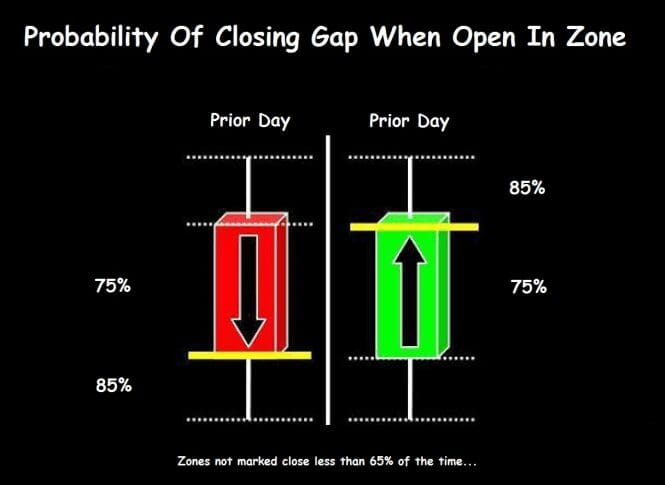
- If yesterday was a UP day and today’s market opens above yesterday’s close (i.e. gap up), then there is an 85% of chance that the gap will be filled today.
- If yesterday was a DOWN day and today’s market opens below yesterday’s close (i.e., gap down), then there is an 85% of chance that the gap will be filled today.
- Suppose, yesterday was a UP day and today’s market opens between yesterday’s open and close (i.e. gap down), then there is a 75% of chance that the gap will be filled today.
- If yesterday was a DOWN day and today’s market opens between yesterday’s open and close (i.e. gap up), then there is a 75% of chance that the gap will be filled today.
Gap Fading: How to Trade Gaps at Opening?
- We will go with the 85% accurate rules of gap trading.
- Look for a stock or index with a strong UP day yesterday. If it opens the gap up today, short sell at open. The first target is 50% of the gap and the final target is full gap fill or gap fade.
- Look for a stock or index with a strong DOWN day yesterday. If it opens the gap down today, buy at the open. The first target is 50% of the gap and the final target is full gap fill or gap fade.
- The stop loss can be at your discretion. If you have a 1% gap, your SL should be at least 0.5%. Hence the more the gap size the more the chance of profit. Let’s check with an example of how to trade gaps at the opening.
- You can find stocks or indices with more than a 1% gap on our NSE stock screener page.
Example Of Gap Fading:
On 16th August 2017 Nifty had a strong rally throughout the day and closed UP at 9897.30. Check the end-of-day chart of the Nifty index below.
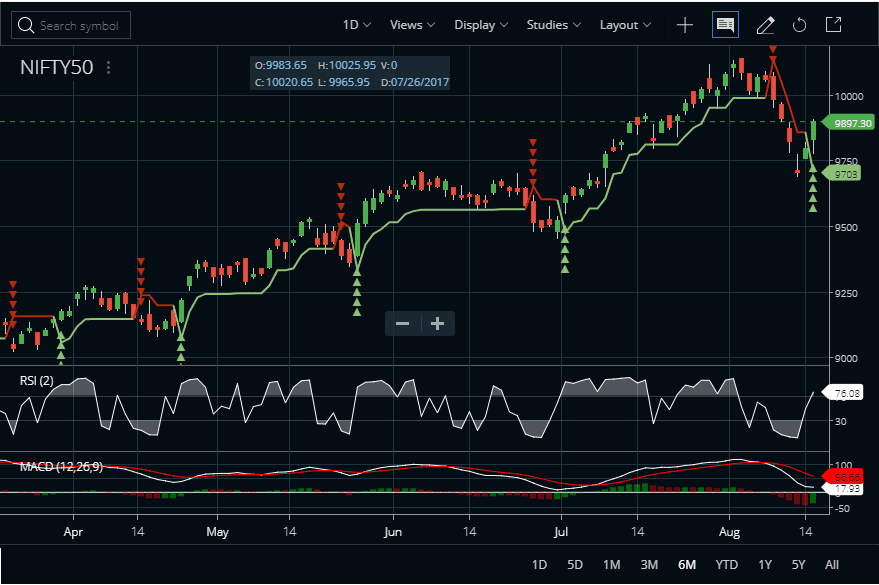
So it was a UP day. The next day, i.e. 17th of August, 2017 Nifty opened a gap up at 9945.55. So it was a gap up of 9945.55 – 9897.30 = 48.25 points. As per the rule, yesterday was a strong UP day and today is again a gap up, so we short-sold the Nifty index in either future or bought puts.
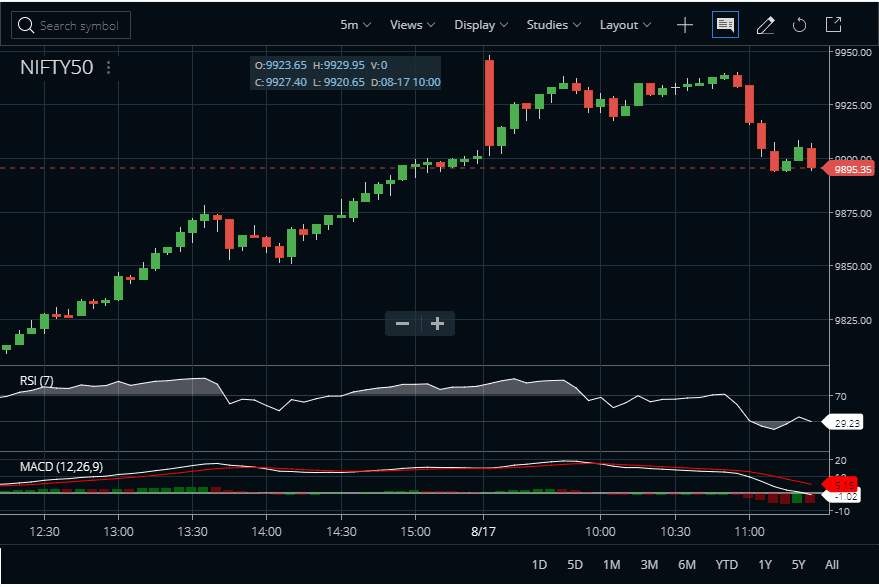
Check the image above how the gap got filled before 11:30 AM. A net profit of 48.25 points or an intraday profit of 48.25 x 75 = Rs. 3618.75 per lot size of 75 in Nifty. This was a typical example of how to trade gaps at the opening. You can also try buying the stocks at open on gap down after a strong DOWN day. I will be happy to answer your comments in this regard.
Trading with Gap Zones: Advanced Intraday Gap Trading Strategies
- Advanced gap trading uses gap zones. See the image above.
- Look for a gap below R1 or above S1 of the daily pivot levels of the previous day’s close. A gap above R1 or below S1 has less chance of fading.
- Look for liquid and volatile stocks.
- If the opening gap (regardless of the direction of the gap) falls within the previous day’s candle body, there is more than a 75% chance of filling the gap.
- Following a down day, if the gap falls between the previous day’s low and close, there is an 85% chance of closing the gap.
- Similarly, following an up-moving day, if the gap falls between the previous day’s high and close, there is an 85% chance of closing the gap.
- Short at opening price = high price, target 50% of the gap, stop loss = yesterday’s high (presuming other conditions are favorable).
- Long at opening price = low price, target 50% of the gap, stop loss = yesterday’s low (presuming other conditions are favorable).
- Trade along the direction of the gap if opening price > R1, stop loss R1 – 5 points., target 50% of the 5-day Average True Range (ATR).
- Trade along the direction of the gap if opening price < S1, stop loss S1 + 5 points., target 50% of 5-day ATR.
- To calculate the high probability of a gap trading range – calculate 40% of the last 5-day ATR and add it with the previous day’s high and subtract the same number from the previous day’s low – you get an approximate gap trading range.
More Example Of Intraday Gap Trading Strategies
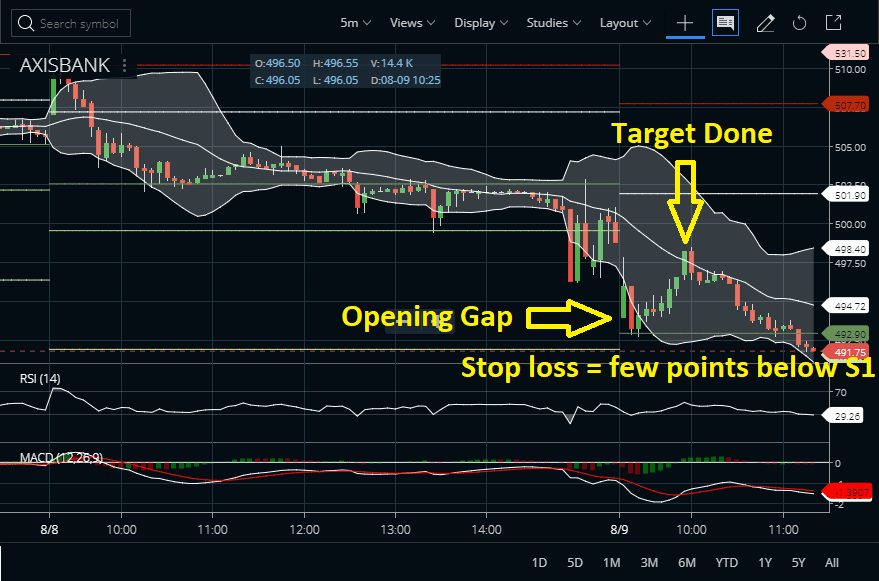
On 9th August 2017, after the market opened, we checked Axis Bank has made a more than 1% downside gap. The open want is not below S1. The open was below the low of yesterday. So we went along with a target of 50% of the gap with a stop of S1 – 5 points (check the above rule). Axis Bank has done the target of 50% of the opening gap within 45 minutes of opening.
How to trade gaps in a volatile market?
The key to success is identifying the correct trend direction, then entering a pullback in the direction of the trend, and then finally ensuring quick profit booking to lock in gains.
Scott Andrews 12 Reasons To Trade Gaps
The GURU of gap trading is Scott Andrews, The Gap Guy. He has his famous 12 reasons to trade the gap. He revealed his gap-trading techniques in his famous book Understanding Gaps. These rules are as follows:
Gap trading has a powerful bias and edge. Over the past decade, 72% of all gaps in the S&P 500 futures market have been filled by the end of the day. There are three to four gap opportunities each week on average, so we are not dependent upon that one winning trade to hit our goals.
Learning how to trade gaps is easy – no need for complex entry timing, scanning 100s of stocks at night, or watching charts all day. You can even do it remotely with minimal slippage and controlled risk as targets are pre-defined. And you’re safe if markets plunge as this setup works equally well into bull or bear trends without trying to guess future price moves! Plus it’s widely applicable across different asset classes including equities, futures, and currencies that use stocks, options, or futures contracts.
You can consistently add a few percent per month in gains (plenty more potential!) while only focusing on one market without managing trades afterward unless you want extra profits. What’s great is this technique also helps optimize swing and position entries throughout the rest of the trading day, so understanding before and after gaps fill gives you an edge too!
My Gap trading rules
- Don’t trade breakouts. A fake breakout can happen
- Watch the breakout of the first half an hour. The breakout of the first half-hour can set the mood of the day.
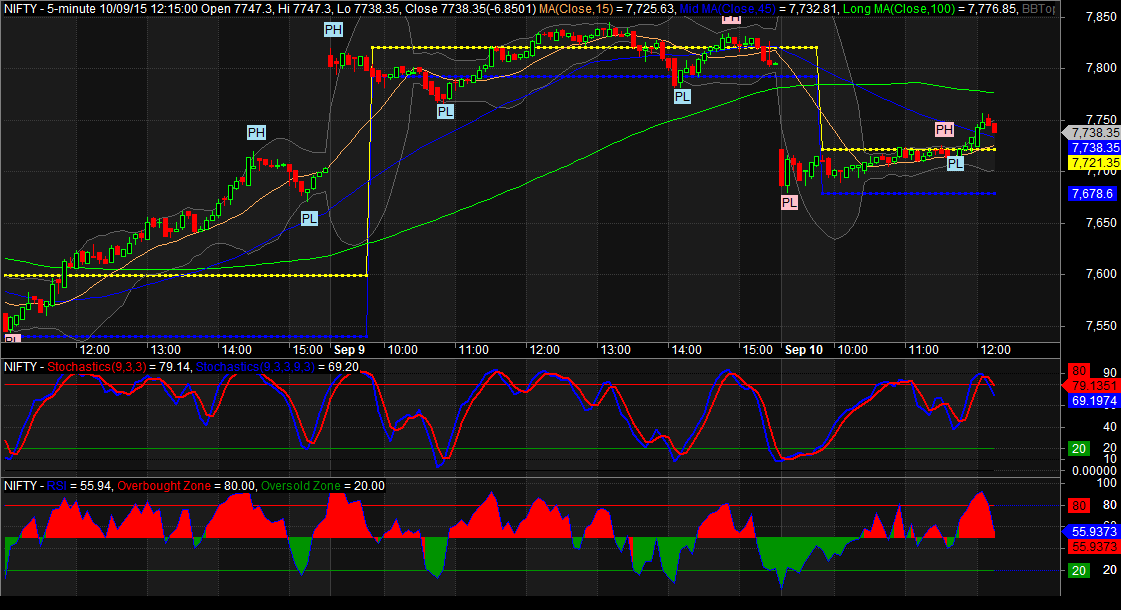
- If the breakout of the first half-hour is on the upside never try to short the market till 1:00 PM. Rather try to buy in dips of the RSI indicator. Sell in rallies of stochastics or RSI.
- If the breakout of the first half-hour is on the downside never try to buy the market till 1:00 PM. Rather try to short in rallies of the RSI indicator. Cover in dips of stochastics oscillator or RSI.
This trading style till 1 PM is called the lunch trick. This works almost 80%-90% of the time in gap days. Check the image above for more clarification. For any further queries, I will encourage comments below the post
FAQs on Gap Trading Strategies
Gaps can be profitable for traders when an understanding of the technicals behind them is developed. To best profit from gap trading, focus on analyzing the news creating the gap. Then use price action analysis to identify entry & exit points based on support or resistance levels.
Intraday strategies vary depending on a trader’s goals and individual risk tolerance. Generally, day-trading strategies involve scalping (entering trades lasting just a few minutes), trend following with breakouts or pullbacks, or even range trading strategies such as buying dips & selling rallies.
With proper knowledge and manipulation of market conditions, traders may find openings in the markets through different types of gaps that offer opportunities to take advantage of and potentially make profits from short-term movements in price. Nevertheless, there are always risks associated with any form of investment so caution should be taken before entering into active positions.
Conclusion
In conclusion, intraday gap trading strategies can be a profitable and straightforward approach to trading in the stock market. By identifying gaps in price, traders can take advantage of market inefficiencies and make profits without the need for complex analysis. The use of strict stop losses and understanding market bias can further improve the success rate of these strategies. However, it is essential to note that no trading strategy is foolproof, and losses are still possible. Overall, gap trading can be an excellent tool for both new and experienced traders to add to their arsenal.